
| Author | Dean Marc |
| Conducted under | Birkbeck, University Of London, Business, Political Economy And Society |
| Originally dated | 09 September 2023 |
This is a condensed edition of the paper. Every sentence is the author's own, taken from the full text. The complete text, charts, figures, bibliography and annex appear in the downloadable PDF. The interactive companion turns the proposed model into something you can click through.
Summary
This study aims to explore and investigate the contemporary perceptions, understanding, and implicit semantic meanings of cyber and cyberspace. While the concepts from the surface and within common social conversational context seem simple and obvious, deeper investigation of literature and institutional policy doctrines reveals that prevailing definitions have minimal mutual understanding, and that definitions of scope, scale, and semantics are sector specific and minimally transferrable to other contexts. It also overlaps excessively with adjunct conceptual entities like 'digital', 'internet', 'Internet', virtual worlds, metaverse, and others creating ambiguity and conflicts. Additionally, a sub-function of cyber, namely cybersecurity, became the proxy and de facto entity that represents the cyber practice across public policy, private enterprises and investments, and military or institutional domain definitions. Key questions centre around (i) the definition and scope of what cyber and cyberspace are from the perspective of institutions and its people, be it in the public sector or private enterprises; and (ii) how this relates to the direction, maturity, competitiveness, adaptability, trustworthiness, and effectiveness with its organisational purpose. The research process embodied an overarching qualitative grounded theory methodology, using only minimal assumptions as anchor concepts or scaffolds for taxonomy. These conceptual frameworks were mainly based on information systems theory, enterprise architecture paradigms, and prevailing doctrines defined by large institutions like the military and its sovereign state. The assumptions and propositions initially established were enhanced and expanded significantly based on wise feedback and actionable insights that were in fact, already in practice for organisations and functions that have achieved a high level of maturity, regardless of variances in the sophistication it entails. This allows or enables effective and competent delivery of the purpose of the organisation, thus ultimately leading to public trust in institutions, customer satisfaction for private enterprises, and social benefit when waste and needless ambiguity are given clarity.
5.1. Reflections On The Research Process 56 5.2. Proposed Global Cyber Architecture Model 57 5.3. Description Of The Proposed Model 58 5.4. Justification And Rationale 60 5.5. Potential Implications And Benefits 61 5.6. Limitations And Challenges 62 5.7. Policy Recommendations 62 5.8. Academic Contributions 63 5.9. Suggestions For Further Research 64 6. References 66 7. Bibliography 76 8. Annex 83 8.1 List Of Abbreviations 83
1. Introduction
1.1. Rationale, Context, And Background
Cyberspace, as a continuously transforming and complex conceptual and notional entity (Caton & Bartholomees, 2012), embodies a multifaceted fusion of technologies, activities, and realms, defying categorisation as a monolithic or isolated construct (Crowther, 2017; Fanelli, 2016). This intricate blend, encompassing domains such as military, governance, commerce, infrastructure, and socio-technical systems, eludes simplified representations in contemporary dialogue and technological methodologies (Choucri, 2015; Crowther, 2017; Dunn Cavelty & Egloff, 2019; US DoD, 2022). In light of this complexity, this research is oriented towards an exploration of the background, semantic evolution, conceptual scope, and functional applicability of terminologies such as cyber, cyberspace, cybersecurity, and cyber maturity.
By employing rigorous scrutiny of scholarly literature, policy papers, and integrating insights from various disciplines and expertise, the study sets out to achieve a thorough but pragmatic examination of prevailing intellectual schools of thought on cyber taxonomy. It will build upon established cyber maturity models and structural designs, synthesising case studies and foundational technical tenets, to devise a renewed and formalised construct of the cyber domain. The objectives extend to uncovering and rectifying gaps within existing literature, accommodating newly arising socio-technological interactions, and broadening the scope of cyber maturity interpretation across diverse fields of study.
1.2. Research Objectives And Questions
Central to this scholarly exploration are a pair of interlinked enquiries:
(a) In our evolving digital epoch, how do institutions or organisations — encompassing both the labyrinthine corridors of public governance and the dynamic arenas of private enterprise — articulate and interpret the constructs of 'Cyber' and 'Cyberspace'?
(b) In what manner do these institutional articulations act as navigational beacons, influencing and moulding overarching agendas related to competitiveness, maturity, evolution, trustworthiness, and operational efficacy?
At the base for this research is an in-depth study of the UK's National Cyber Strategy. This document or set of documents and sub-strategy papers, emblematic of a nation's ambition and trajectory in the cyber realm, will be the primary beacon illuminating our understanding of cyber maturity, its inherent resilience, and its ever-evolving capabilities (HM Government, 2022a). To enrich this foundational exploration, we shall traverse the landscape of documentation from an array of UK governmental entities. As elucidated by thinkers like Galston and McElvein (2015), such national strategies are not mere policy papers; they are complex fabrics with threads of technological nuances, political motivations, economic imperatives, and overarching strategic visions — each reflecting and influencing global trajectories.
1.3. Significance
Anchored at the nexus of the ever-expanding realm of cyberspace and its geopolitical ramifications, this research casts a discerning eye on institutional perspectives vis-à-vis cyber maturity. In an age where cyberspace is progressively intertwined with global technological, economic, and strategic tenets (Dun Cavelty & Egloff, 2019; Keohane & Nye, 1998), the urgency for cogent cyber paradigms reaches a crescendo. Through this analytical journey, the study underscores the ripple effects engendered by terminological discrepancies within the 'cyber' nomenclature, shedding light on their manifestation in varied policy echelons of nations and organisations (Hathaway 2013; Luiijf et al, 2013).
One cannot overstate the gravity of the study's geopolitical underpinnings. As cyberspace emerges as the modern-day crucible where power structures are both challenged and redefined (Choucri, 2012; Cordesman, 2022; Dunn Cavelty & Egloff, 2019), there emerges an exigency for cyber blueprints that balance the scales of competition with foundational pillars of trust and collaboration. In this evolving schema where cyber instruments often overshadow traditional geopolitical channels (McGuffin & Mitchell, 2014), the quest for robust, encompassing frameworks gains pronounced importance.
2. Critical Review Of Literature
2.1. History
Tracing its etymological roots to the Greek word "kybernetes" or steersman, the term "cyber" has undergone a multifarious transformation in its interpretation and application throughout history. The semantic trajectory of "cyber" and "cyberspace" has continued to diversify, evolving in tandem with the varied perspectives and agendas of stakeholders across disciplines (Caton & Bartholomees, 2012; Kreuzer, 2021), the nuances of public discourse, and the shifting paradigms within the technological and sociopolitical landscapes (Choucri, 2015; Beecroft, 2021).
In its embryonic stages, mathematician Norbert Wiener applied the term to the nascent field of cybernetics in 1948, highlighting the self-directed control and regulation inherent within mechanical and biological systems (Wiener, 2019). Subsequently, the term was employed by Danish architects in the 1960s to describe an architectural ethos envisioning open and adaptable sensory environments devoid of technological interference (Lillemose & Kryger, 2015). By the 1980s, the term had permeated the realm of science fiction, with William Gibson conceptualising "cyberspace" as a collective digital repository housing the entirety of human-computer interaction, visually depicted in his works "Burning Chrome" (Gibson, 1988) and "Neuromancer" (Gibson, 1984).
2.2. Fundamentals
The pervasive and extensible reach of cyberspace transcends geographical boundaries (Gao et al, 2019; HM Government, 2022a; Van Haaster, 2016). This, for example, allows for instant global communications among its many other utilities. As a web of interdependent elements by which an action in one area can impact the entire system, the interconnectedness of cyberspace offers benefits to millions and billions of users, but consequently and inherently becomes prone to disruption if key components or entities in the underlying system become faulty (Castell, 2010). As an ever-evolving construct, new technologies, applications, and threats emerge regularly (Demchak, 2020; Libicki, 2021). It entails a vigilance across a multitude of entities and actors within the system to keep the system operating. The ubiquity, virtuality, and decentralisation of cyberspace through the rise of Internet-connected devices such as IoT and smartphones has woven cyber realities into daily physical existence (Choucri, 2012). This facilitation through complex computing systems enables novel interactions like online gaming, digital currencies, online shopping, social media, and other key access to government services (Castell, 2010). This decentralisation enhances the distribution of data and services but implicitly complicates governance (Betz & Stevens, 2011) and oversight as well as introduces further challenges to privacy and identity management.
2.3. Information Systems
Using the perspective of information systems theory, the virtual realm where digital communications occur, the intricate interplay of people, processes, technology, governance (McMullen & Schneider, 1972; Gregor, 2006), and other factors defines the digital landscape (Checkland, 1988; Orlikowski & Robey, 1991). From this vantage point, the theory transitions into practical and tangible constructs. In other words, this global domain ultimately comprises an interconnected network of information technology infrastructures, including the Internet,
telecommunications networks, computer systems, embedded processors, and controllers (Porter & Heppelman, 2014). This becomes a very pragmatic baseline of components that can be itemised in further discourse, highlighting that while abstractions are useful, the underlying physical reality remains a fundamental pillar in the taxonomy of concepts (Greer et al., 2019).
Hardware represents the tangible components of cyberspace, such as computers, servers, routers, cables, satellites, and more, which underpin digital communication (Jazdi, 2014). It encompasses the devices that individuals use daily, as well as the infrastructure that enables worldwide connectivity. Software, consisting of digitally stored data that guides hardware operations, plays a critical role. Ranging from operating systems like Windows or Linux to applications and protocols that facilitate data transmission, software powers the myriad digital interactions that occur daily (Ning et al., 2018). Networks, or interconnected groups of devices, facilitate communication and data transfer. They vary in scale from global structures like the Internet to local networks such as a home Wi-Fi system. These networks enable data transmission and access to digital services worldwide. Data encompasses all digital information created, stored, manipulated, and transmitted across networks. It can take various forms, including text files, images, audio, and video. The exchange of data is integral to the functioning of cyberspace, enabling individuals and organisations to communicate, share, and interact (Choucri, 2012; Choucri, 2015). Devices, which include computers, smartphones, tablets, and smart devices (IoT), serve as gateways to cyberspace. These points of access allow users to engage with the digital world, facilitating activities such as web browsing, communication, and content consumption. Users, consisting of individuals, organisations, and government entities, interact within the digital landscape.
2.4. Cities And Urbanisation Parallels
At the heart of a city's birth lies its physical and geographic setting. The bounty of a river, the promise of fertile land, or the lure of trade routes – these are the primal calls that summon cities into being (Bettencourt, 2012). In parallel, the birth of cyberspace owes itself to physical environments: the whirring hardware, the humming servers, and the vast web of networks that interlink them. Like cities, cyberspace has its foundation in the physical and the tangible.
As cities grow, they become teeming hubs of humanity, populated by people who navigate a dense forest of objects – buildings, streets, and vehicles. These objects, infused with life and purpose by their inhabitants, come together to create the unique tapestry of a city's culture (Mumford, 1961). Similarly, cyberspace thrives on the interaction between users and digital objects – websites, applications, and data streams (Clarke, 2010; Dunn Cavelty & Egloff, 2019). Together, they form the vibrant, evolving culture of the online world.
2.5. Business, Political Economy, And Society
The intricate ecosystem of cyberspace facilitates global connectivity and innovation, fostering new business models and marketplaces akin to the rise of urban commercial centres (Sassen, 1991; Castells, 2010). Examples include the emergence of online marketplaces such as Amazon and Alibaba. However, this increased interconnectedness also accentuates cybersecurity vulnerabilities (IISS, 2021), necessitating robust risk management strategies and the adoption of standardised security protocols (Carr, 2012; Choucri, 2015; Jabbour & Devendorf, 2017). Just as cities drive economic specialisation and diversification (Florida, 2002), cyberspace spurs competitive advantage and differentiation through the adoption of digital technologies (Porter & Heppelmann, 2014).
The digital realm's analogue to cities extends to the political economy, where the management of resources, power dynamics, and regulations shape the contours of the cyber world (Clarke, 2010; Dunn Cavelty, 2013). As governments attempt to exert control over cyberspace through regulatory frameworks, questions of sovereignty, jurisdiction, and transnational cooperation arise (Dunn Cavelty, 2019). The internet's borderless nature and decentralised architecture challenge traditional notions of statehood and territoriality (HM Government, 2022a; HM Government, 2022b). Moreover, the digital economy's role in reshaping labour markets, production, and consumption patterns echoes the transformative effects of urbanisation on economic structures and employment (Florida, 2002; HM Government, 2021).
2.6. Domain For Military And Government Strategy And Operations
The emergence of cyber as a domain for military and government strategy and operations can be traced back to the development of the internet in the 1960s (Caton, 2018), initially intended as a way to maintain military communications in the event of a nuclear attack (Castells, 2010; Choucri, 2012). At the centre of this new domain from government and military vantage point is "cyber warfare," defined as the actions by a nation-state or international organisation to attack or defend information and other computer systems in cyberspace (Choucri, 2015; Demchak, 2020).
Cyber as a domain for military and government strategy also involves defensive and offensive operations, including cyber espionage, intelligence gathering, and the development of cyber capabilities for strategic deterrence (Libicki, 2021). The cyber operations of nation-states have included the surveillance of foreign governments and organisations, as well as the theft of intellectual property and sensitive information (Savaş & Karataş, 2022). The cyber domain's role in military operations (Crowther, 2017) is further evidenced by the 2010 Stuxnet attack on Iranian nuclear facilities, a joint operation by the U.S. and Israel that utilised a malicious computer worm to disrupt centrifuge operations (Carr, 2012).
2.7. Present And Future Workloads
In the realm of political economy, cyberspace has reshaped power dynamics, governance, and resource management, prompting questions about sovereignty, jurisdiction, and international cooperation (Nye, 2011; Nye, 2017). At the societal level, cyberspace fosters communication, expression, and community-building while simultaneously exposing society to challenges such as misinformation and privacy breaches (DiResta et al., 2018; Tucker et al., 2018). As cyberspace evolves, it reflects the diverse realities of different countries, regions, and contexts, making its future trajectory complex and multifaceted (Caton, 2018). To navigate this complexity and sustain progress, it is imperative to have foresight that considers the environmental sustainability of cyberspace, addressing issues related to equitability, energy consumption, and potential harm to the natural environment (Greer et al., 2019; Hathaway, 2013).
The global data deluge, driven by the proliferation of digital devices, IoT deployments, and growing user connectivity, has considerably increased the workload of data transmission across cyberspace (Eom et al., 2012). As the volume and velocity of data continue to grow,
2.8. UK Perspective, A Starting Point
The UK's history in the domain of information sciences and technology is indeed illustrious. From early contributions to digital numerical systems to theoretical machines capable of automating maths operations, the UK has been at the forefront of digital innovation, often in collaboration with experts and scholars worldwide (British Academy, 2022; IISS, 2021). The rise of the UK to technological prominence is analogous to its leadership during the Industrial Revolution. However, the current multipolar evolution of information technology contrasts with the UK's historical imperial ascendancy (House of Lords, 2022; Jazdi, 2014).
Recent literature and reports showcase the UK's sustained influence in various spheres (HM Government, 2021; House of Lords, 2022; Nye, 2011). Key strengths include an open political environment, a developed economy, an advanced education and research ecosystem, and a hub for leading enterprises in Europe. The UK's leadership in addressing challenges such as climate change and its role in global security and diplomacy underscore its influence. Its soft power extends across numerous domains, and its role as a hub for science and technology investment has positioned the UK as a force for innovation across sectors like biotechnology, finance, and energy (House of Lords, 2022; Nye, 2005). The influx of foreign and domestic investments further highlights the UK's leadership in the global economic landscape (HM Government, 2021).
2.9. Broader Comparative Analysis
The UK's approach to cybersecurity and digital strategy is just one perspective in a complex and interconnected global landscape (MoD 2022b). Various states, transnational organisations, and other stakeholders exert their influence in cyberspace, and the actions of one entity often have ripple effects that impact the broader community.
The United States is a dominant force in cyberspace, with a robust cyber ecosystem that encompasses the private sector, government, and academia. The US's National Security Strategy highlights the importance of securing cyberspace as a vital component of its national security efforts (US DoD, 2022; US DoD, 2023). However, the country's decentralised approach has often led to a fragmented cyber policy landscape that is influenced by diverse stakeholders, including technology giants and civil society organisations.
NATO, as a military alliance, has increasingly recognized the significance of cyberspace in warfare and has developed strategies and doctrines to defend against cyber threats (NATO, 2022). The alliance has worked to integrate cyber capabilities into its military operations and has established the Cooperative Cyber Defence Centre of Excellence to promote research and collaboration among member states (NATO, 2022). The European Union has taken significant strides to establish a cohesive approach to cybersecurity. The EU's Cybersecurity Strategy for the Digital Decade aims to build a secure and resilient digital space, protect critical infrastructure, and foster innovation (European Commission, 2020). As part of this strategy, the EU has focused on establishing a robust regulatory framework, as seen in the General Data Protection Regulation (GDPR) and the Directive on Security of Network and Information Systems (NIS Directive) (European Commission, 2020).
2.10. Identification Of Gaps In Existing Literature
Scholars have critiqued the inadequacy of current global cyber architectures, emphasising their fragmented technical and policy approaches (Choucri, 2012; Dunn Cavelty & Egloff, 2019). Political economic factors significantly shape cyber strategies, as state-centric paradigms overlook the growing influence of non-state actors and economic interdependence (Keohane & Nye, 1998). Power imbalances persist, particularly through control over digital infrastructure and standards (Betz & Stevens, 2011; Dunn Cavelty, 2021).
Institutional practices often infringe on privacy, rights (Mearsheimer, 1994), and freedoms in cyberspace governance (Cox & Kanji, 2022; Deibert et al., 2008). Examples like China’s censorship and monitoring systems illustrate the risks of prioritising security and surveillance (Gao et al., 2019). Pluralistic governance and participatory policymaking are called for (Chang & Grabosky, 2017).
3. Research Methods
3.1. Research Design
The objective of detailing the methodology is to provide a clear, comprehensive account of the approach taken to conduct and evaluate the research in a rigorous and systematic manner. As noted by Blumberg et al. (2014), a thorough explanation of the methods used is critical for assessing the reliability, validity, and objectivity of the research findings. By detailing the design, data sources, analysis strategy, and any limitations, this section aims to enhance the reader's understanding of how the investigation was methodically carried out to produce credible, evidence-based insights that address the research objectives.
Ontologically, this study embraces subjectivism, acknowledging that multiple participant realities are influenced by social, political, and economic contexts. This acknowledgement is evident, for instance, in the varying perspectives on data privacy between the private and public sectors. Epistemologically, the study employs an interpretivist perspective, viewing knowledge as contextually situated and generated through insider perspectives rather than external generalisations (Creswell, 2009).
3.2. Sampling Strategy
The sampling strategy was informed by a desire to provide a comprehensive and well-rounded perspective on cyber maturity, cybersecurity, and other cyber considerations. In line with recommendations by Mason (2002), it employed a purposive sampling strategy to select key stakeholders from leading businesses, government institutions, and social NGOs, as these individuals and organisations have direct involvement in the development and implementation of cyber policies and strategies. Engaging with these stakeholders allowed us to capture insights from those directly responsible for shaping cyber policies and those affected by these policies (Bell et al., 2022).
To ensure diversity within the sample, we followed the principles of stratified sampling, as outlined by Creswell (2009), by speaking with individuals across various levels of authority, from frontline staff to senior leadership. We also engaged with individuals who have varying levels of subject matter expertise and knowledge, including both cybersecurity specialists and generalists. This approach allowed us to capture a broader range of perspectives and insights, which is essential for understanding the complex and multifaceted nature of cyber maturity issues.
3.3. Data Collection Methods
The data collection steps include setting the boundaries for the study, collecting information through unstructured or semistructured observations and interviews, documents, and visual materials, as well as establishing the protocol for recording information (Saunders et al., 2019). For the purposes of this study, feedback from diverse groups provides crucial source qualitative data. Experts who were identified and pursued include those working in private or public companies, organisations, businesses, academia, and think tanks focused on implementing cyber, information technology, and other related products.
While field research interviews were largely opportunistic and ad-hoc, expert interviews were carefully scheduled and coordinated with accessible government bodies, industry experts, companies, and professionals. These interviews were conducted either face-to-face or through online methods such as video conferencing or voice calls. In cases where scheduling difficulties arose due to time zone differences or the interviewee's availability, an interview questionnaire was sent via email to allow the interviewee to respond at their convenience. The same questionnaire was used for all interview formats, whether in-person, online, or offline asynchronous interviews. Responses were collected on an online data entry platform, ensuring that the knowledge base was centralised and organised in a consistent manner from the outset, regardless of the mode of conversation.
3.4. Data Analysis Methods
Qualitative data analysis involves interpreting complex and nuanced information from sources like interviews and open-ended surveys. It relies heavily on making sense of unstructured human communications and subjective responses. This makes the process inherently intricate.
The operational research activities in this study predominantly focus on the viewpoints and feedback of various stakeholders concerning cyber and cyberspace realities. These stakeholders include government officials, subject matter experts, private sector vendors, academic researchers, professional practitioners, and ordinary citizens or the persona of an ordinary citizen while speaking with experts.
As a supplement to initial samples or contacts for discussions, we also used a combination of snowball sampling to identify additional participants through referrals from initial participants and convenience sampling to select participants based on their availability and willingness to participate. The author was able to engage with these actors within the limitations of the available budget and time resources. The initial plan was not always applicable without changes and adaptation.
3.5. Ethical Considerations
The research adhered to key ethical principles including voluntary participation, informed consent, anonymity and confidentiality. All questionnaires and interviews explicitly emphasise these standards.
The participants were clearly informed about the study purposes and procedures and they can freely decline to participate or withdraw at any time without repercussion. All
participant identities and responses are also kept anonymous. No identifiable data will be published.
Furthermore, the United Kingdom regulations and guidelines on privacy, data management, and subject protections were followed diligently. Participants can choose to not disclose any business information, sensitive data or government details they prefer to keep confidential. No pressure will be applied regarding disclosure.
4. Findings And Analysis
4.1. Conceptual Framework
This research employed a multi-perspective theoretical framework, synthesising insights from several fields including political science, international relations, organisational design and management, information systems theory, enterprise architecture, and technology governance (Colomb, 2005; Kottemann & Konsynski, 1984). As the subject of cyber maturity is an intricate interplay of social and technical factors, an integrative approach was needed (Gregor, 2006; Jabbour & Devendorf, 2017; Kottemann & Konsysnski, 1984; Matlin & Land O’Lakes, 1979; McMullen & Schneider, 1972).
In the analysis of national cyber strategies, this study leveraged political science and international relations theories that addressed power dynamics, national interests, and competition and cooperation among states (Keohane & Nye, 2011). Rather than adhering strictly to traditional theories such as realism and liberalism (Mearsheimer, 1994), the research
expanded upon these by incorporating constructive and critical perspectives that considered the roles of norms, identity, and discourse in global policy-making (Barnett & Duvall, 2005).
In examining organisations, the study was informed by institutionalism, which provided a framework for understanding governance, culture, capabilities, and strategic orientations within institutions (North, 1991; Peters, 2012). However, this was further enriched by multilevel and social institutionalism (Colomb, 2005; Powell & DiMaggio, 1991) and complemented by theories from organisational psychology and behaviour that explore cognitive processes, motivations, and group dynamics (Peters, 2012).
4.2. Selection Of Specific Case And Context
This research employed a qualitative approach grounded in an interpretivist paradigm to investigate diverse perceptions of cyber maturity. By utilising semi-structured interviews and surveys, this study sought to gather insights from a broad spectrum of participants, including technology professionals, public administrators, industry leaders, civil society groups, and citizens. This inductive approach enables theories and insights on cyber maturity to emerge naturally from the data, rather than imposing existing hypotheses (Creswell, 2009).
Our exploratory and investigative trajectory sought insights from four broad categories of stakeholders: (a) Leaders or Managers in public sector entities,
(b) Professionals or Subject Matter Experts in public sector entities, (c) Leaders or Managers in private enterprises, and (d) Professionals or Subject Matter Experts in private enterprises,
Their feedback and perceptions were critically analysed against: (a) The broader cyber landscape, (b) Cyber architecture or domain paradigms, (c) Dynamics of cross-sector interactions, and (d) Other prevalent sentiments and informed perspectives.
4.3. Presentation Of Findings
The research approach, predominantly qualitative in nature, found its grounding in the empirical data derived from extensive expert interactions. Lexical statistics from these dialogues informed and influenced subsequent expert interactions, offering a dynamic and responsive feedback loop.
Logistical assumptions, concerning research location and scheduling, were largely corroborated. Unexpected yet fruitful interactions occasionally emerged during expert liaison, enriching the dataset and broadening the research's purview.
While the author and the process were primarily based in the United Kingdom, the research process transcended and remained liberal with geographical confines. It engaged in
dialogues and gathered data from a wide range of professionals: ranging from leaders and subject matter experts to domain specialists, in both the public and private sectors.
It is noteworthy to highlight the geographical spread of respondents to provide context for the global relevance of our research findings. The highest volume of responses was registered from the following locations, thereby elucidating the primary regions contributing to this dataset:
This geographical dispersion not only enhances the richness of our dataset but also offers a multifaceted perspective that accounts for regional variability in practices, policies, and perceptions.
While the numbers seem skewed to certain locations that may reduce the validity and reliability even further from a qualitative point of view, the contextual and commercial underpinnings of location sensitive categorisation is often missed. For example, the UK and Singapore are in fact representative of regional and global organisations or ecosystems. This was explicitly mentioned in discussions the research engaged with. The minimal representation of Canada, Ireland, and the United States of America, is partly an administrative limitation as well as a logistics constraint with regards to practical scheduling and coordination.
4.4. Summary Of Research Findings
It was a key pillar of the activity to take into account basic historical meaning drifts as the concept of cyber has been used and evolved in various contexts. The interviews, surveys, and analysis enacted worked toward a balanced population of subject matter experts, domain experts, organisational management, and other administrative leadership involved in the public and private sphere.
Cyber, a term often confined to specific domains, is more aptly understood as a ubiquitous field that seamlessly integrates with and enhances all human and machine-operated domains. In line with contemporary discourse and research (Choucri, 2015; Clarke, 2010; Wren, 2015), these definitions have incorporated operational considerations (Maurer & Morgus, 2014) reflective of the real-world industry, encompassing emerging communication protocols beyond Transmission Control Protocol over Internet Protocol (TCP/IP) such as (a) Supervisory Control And Data Acquisition or SCADA; (b) Cyber-Physical Systems or CPS, and Internet-of-Things or IoT (Ning et al., 2018). Additionally, it also includes hardware resilience mechanisms embedded within systems and software itself, the architecture of networks and subnetworks, access nodes, and the integral role of data (Greer, et al., 2019; Prince & Sullivan, 2019).
5. Conclusion
5.1. Reflections On The Research Process
Outside role-specific sub-functions like cybersecurity, facilities security, or end-user equipment operations, interviewees agreed that the industry and institutions creating policies including major consultancies promote an oversimplification of terms, concepts, and frameworks in the interest of an ‘easy sell’ as one of the domain experts in the telecommunications industry mentioned or as a ‘layman’s version’ of crucial components of processes and procedures to ‘cut through the bureaucracies or to deal with overly incompetent management’ as mentioned by one of the department heads for a government agency in the UK. The research process avoided generalising from individual statements; but it must not discount sincerely provided and consistently competent insights provided by people with authority, subject matter expertise, and integrity, as far as the research can assume. This is echoed in the private sector and in investment circles, where certain sub-functions or ‘feature slices’ instead of complete products or value propositions are highlighted as simplicity even at the expense of coherence gains more attention in the capital markets. This is dangerous in general for society -- even if profitable for small portions of society who benefit despite incompetence, corruption, or parasitic opportunism -- for misappropriated resources is detrimental to the system as a whole.
5.2. Proposed Global Cyber Architecture Model
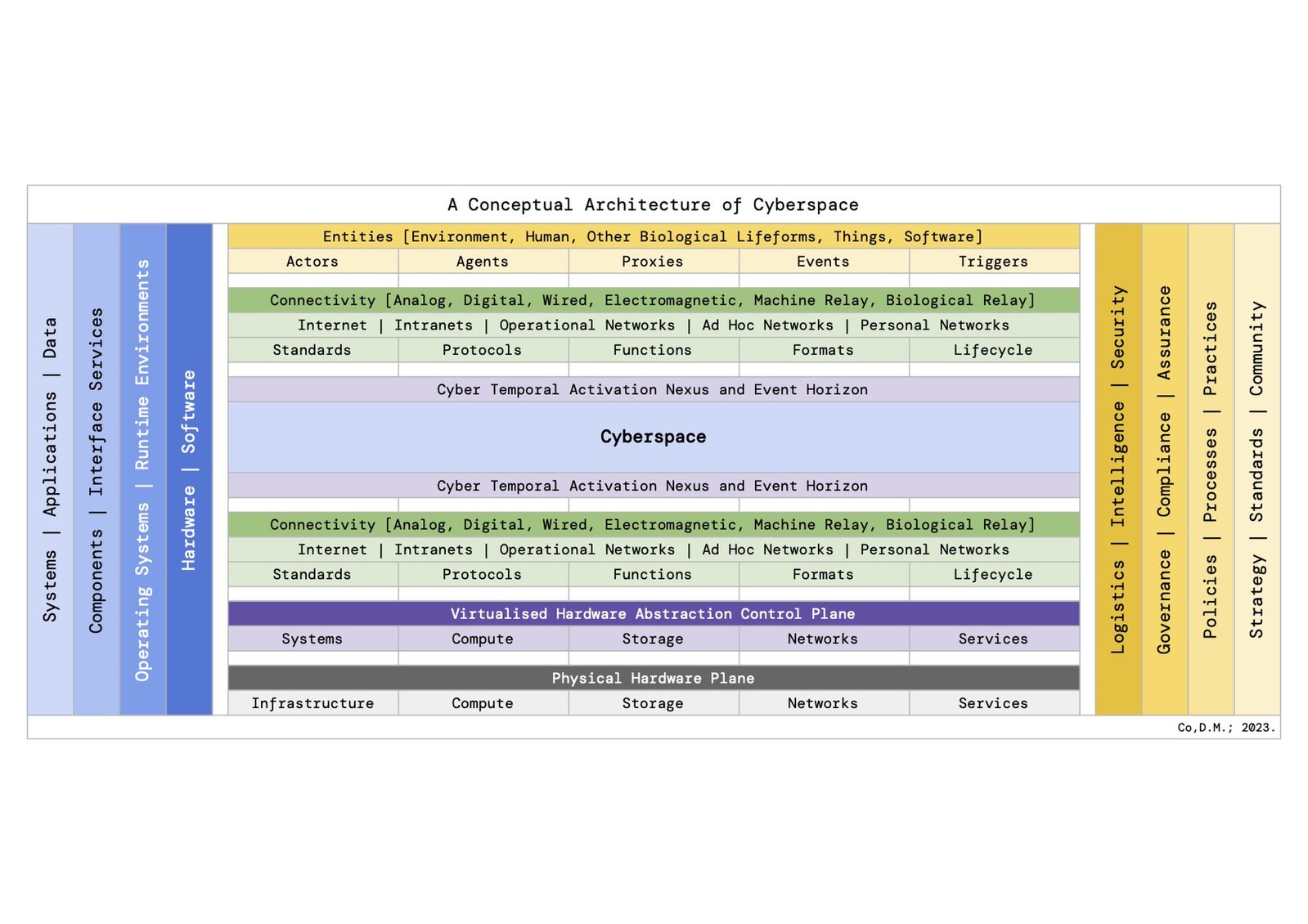
5.3. Description Of The Proposed Model
Central to the proposed architectural paradigm is an intricate, layered stack that progresses from the foundational core physical infrastructure upwards to a more evolved virtualised platform and, ultimately, to an intricate web of connectivity and networking essential for diverse computing requirements.
At the top are terminals and actors. They are representative of diverse interaction points, extending beyond the conventional human-machine interfaces to encapsulate entities such as environmental sensors and adaptive urban infrastructures. Despite their diversity, these nodes converge on a framework of connectivity, encompassing all communication protocols, from conventional ones like Wi-Fi and Bluetooth to niche mechanisms like legacy radio frequency or RF and Internet-of-Things or IoT based protocols.
A novel feature of this conceptualisation is the dynamic entity of 'Cyberspace'. Contrary to traditional definitions that envision cyberspace as a mere digital continuum or domain, our model posits it as a vibrant conduit of data interactions. Particularly, the introduction of the Cyber Temporal Activation Nexus and Event Horizon reiterates the importance of transitional state of data. The transformation from static 'data-at-rest' to kinetic 'data-in-transit' animates this conceptualisation of cyberspace. It draws parallels with biological circulatory systems in its significance and function. In other words, the key aspect of life or the complex emergence of life stems partly from energy in motion, not just ingredients of life in stasis. Similarly, cyberspace is not a space or a domain in a dimensional sense, but is the sum total reality of all data in motion. A gap in the literature, apart from the concept of cyber enabled physical systems, is the concept of the temporal activation nexus and event horizon. This is a crucial aspect of this conceptualisation.
5.4. Justification And Rationale
This research culminated by proposing an integrative conceptual model to enhance global cyber maturity through coherent policymaking, cooperative implementation regulations, and socio-technical integration. The architecture synthesises empirical insights from comparative analysis of institutional cyber perspectives across public, private, and civil society sectors in both developed and emerging economies.
Findings revealed (a) ineffective bureaucracy, (b) incompetent management, (c) technical and process fragmentation, (d) capability asymmetries, and (e) lack of cooperation as key barriers to improving maturity (Brooks, 1995). While progress has occurred in silos, an interconnected global cyber ecosystem demands greater coherence across national boundaries and competing interests (Checkland, 1988; Choucri, 2012; IISS, 2021).
As such, the proposed multi-level and multi-perspective model provides a unifying taxonomy spanning core technical perspectives, functional perspectives, governance perspectives, physical and virtualised infrastructure perspective, terminal and client side perspective, education, professional or guild associations, and comprehensive definitions of partaking and belonging within the construct of cyber domain (Chang & Grabosky, 2017).
5.5. Potential Implications And Benefits
Critical dimensions will emergently emphasise (a) public-private and multi-stakeholder partnerships as distinctions are unified; (b) transparency on threats and vulnerabilities as analysis and response are liberated from siloed priorities; (c) interoperability mechanisms are democratised and expanded as clearer abstraction layers and maturity aware strategies allow for continuous progress (Kottemann & Konsynski, 1984) than top-down large-scale alignment with technical and political hegemony monopolising acceptable progress; and (d) explicit sharing contemporary and emerging good practices that promotes the most good sustainably, rather than adherence to highly contextual best practices that may easily change at points in time. For instance, the model may encourage regional cooperation platforms for coordinating policy and combating cybercrime across borders as a supplement to global multilateralism. Global certification schemes would help improve baseline maturity of small and medium enterprises worldwide.
5.6. Limitations And Challenges
This study navigated through several inherent limitations. Predominantly anchored in the United Kingdom, international interactions were channelled exclusively via online platforms, which may have nuanced the diversity of global insights and limited deeper meaning that may be gleaned through more conversational methods. The 12-week time frame, though intense, curtailed the breadth of exploration possible. The constraints in both coverage and capacity meant that intricate cultural nuances, intricate political contexts tied to budgetary decisions, and extensive longitudinal evaluations were not as comprehensively addressed. Moreover, the detailed cross-disciplinary considerations of such vast domains may not have been fully captured due to the temporal constraints. Operating on a self-funded model also introduced certain resource-related challenges, potentially impacting the depth and expanse of the enquiries. These factors highlight the avenues ripe for deeper investigation in subsequent studies.
5.7. Policy Recommendations
The interplay between cities and cyberspace offers a compelling analogy, a conduit to elucidate the multilayered complexities of the evolving digital landscape and its impact on business, political economy, and society. A careful examination of this relationship reveals striking parallels in their physical, logical, virtual, and social structures, as well as the emergence of governance mechanisms and institutional hierarchies that guide their progression.
These commonalities serve as a valuable analytical lens to understand the far-reaching consequences of cyber activities. Companies must navigate the rapidly evolving digital landscape to remain agile and responsive to shifting market dynamics. Political actors must grapple with the socioeconomic repercussions of the digital revolution, including the
redistribution of wealth, income inequality, and social mobility. Policymakers, stakeholders, and civil society must forge a collective vision to address the challenges and harness the opportunities presented by the digital transformation.
5.8. Academic Contributions
By reframing our understanding of cyber, several pivotal outcomes can be realised: (a) it can liberate unprecedented or stifled innovations and opportunities for differentiating strategies in creative value across numerous sectors and ventures; (b) it can reshape the discourse on the political economy of cyber, allowing us to move beyond traditional military domain delineation, limited cyber security purview, and commercial network of electronic exchange (Caton & Bartholomees, 2012); and (c) it can significantly broaden and variegate the horizon for policy planning, governance institutionalisation, protocol establishment, operational design management, product ideation and development, capability building, lifelong learning, multi-sector innovation, and venture capital investment.
5.9. Suggestions For Further Research
National cyber frameworks, spanning both public and private sectors, often escape systematic comparative scrutiny (Hathway, 2013; IISS, 2021). Notably, the UK National Cyber Strategy (HM Government, 2022a) underscores the urgency for integrated oversight across diverse realms. A comprehensive exploration of international variances in governance structures, legal landscapes, technological mechanisms, and security culture dynamics is paramount. Neglecting this comprehensive perspective risks fragmented strategies and misses the potential to learn vital lessons about resilience and partnership-building.
Existing scholarship frequently gravitates toward the mechanistic aspects of cyber maturity, sidelining the intricate web of geopolitical forces, economic ties, and strategic inclinations of state and non-state players (Carr, 2016; Savaş & Karataş, 2022). Broadening the analytical gaze to capture this multifaceted interplay could guide more cohesive, stable, and inclusive digital futures.
6. References
Australian Government. (2022). 2023-2030 Australian Cyber Security Strategy - Discussion Paper. Available from: https://www.homeaffairs.gov .au/reports-and-publications/submissions-and-discussion-papers/2023-2030- australian-cyber-security-strategy-discussion-paper (Accessed 02 August 2023)
AWS (2023). Cloud Computing with AWS. Available from: https://aws.amazon.com/what-is-aws/ (Accessed 05 September 2023)
Baller, S., Dutta, S., & Lanvin, B. (2016). The Global Information Technology Report 2016: Innovating in the Digital Economy. World Economic Forum.
Barnet, M. & Duvall, R. (2005). Power in International Politics. International Organization, 59(1) (Winter, 2005), pp. 39-75. http://www.jstor.org/stable/3877878 .
Beecroft, N. (2021). The UK’s Cyber Strategy Is No Longer Just About Security. Available from: https://carnegieendowment.org/2021/12/17/uk-s-cyber-strategy-is-no-longer-just-about-security-pub-860 37 (Accessed 20 December 2022)
Bell, E., Bryman, A., & Harley, B. (2022). Business Research Methods (6th ed). Oxford: Oxford University Press.
Berkun, S. (2005). The Art of Project Management. Sebastopol: O’Reilly Media, Inc.
Bettencourt, L. (2012). The Origins Of Scaling In Cities. Santa Fe: Santa Fe Institute.
Betz, D. J. & Stevens, T. (2011). Cyberspace and the State: Toward a Strategy for Cyber-Power. London: Routledge.
Blumberg, B., Cooper, D. & Schindler, P. (2014). Business Research Methods (4th ed). Maidenhead: McGraw-Hill Education.
British Academy. (2022). British Academy response to the House of Lords Science and Technology Committee Inquiry on Delivering a UK Science and Technology Strategy. Available from: https://www.thebritishacademy.ac.uk/documents/3740/British-Academy-Response-to-Delivering-a-UK-ST- Strategy_lcKJIbV.pdf (Accessed 18 December 2023)
Brooks Jr., F. (1995). The Mythical Man-Month: Essays on Software Engineering, Anniversary Edition. Crawfordsville: Addison-Wesley.
Carr, J. (2012). Inside Cyber Warfare (2nd Ed). Sebastopol, CA: O'Reilly Media Inc.
Castells, M. (2010). The Rise of the Network Society (2nd ed). West Sussex: Wiley-Blackwell Blackwell Publishers.
Caton, J. L. & Bartholomees, J. B. (2012). On The Theory Of Cyberspace. In Volume 1: Theory Of War And Strategy, pp. 325–344. Strategic Studies Institute, US Army War College. http://www.jstor.org/stable/resrep12116.26
Caton, J. L. (2018). The Land, Space, and Cyberspace Nexus: Evolution Of The Oldest Military Operations In The Newest Military Domains. Strategic Studies Institute, US Army War College. http://www.jstor.org/stable/resrep17662
Chang, L. Y., & Grabosky, P. (2017). The governance of cyberspace. In P. Drahos (Ed.), Regulatory Theory: Foundations and Applications, pp. 533–552. ANU Press. http://www.jstor.org/stable/j.ctt1q1crtm.42
Checkland, P. (1988). Information Systems and Systems Thinking: Time to Unite? International Journal of Information Management, 8(1988), pp. 239-248.
Choucri, N. (2012). Cyberpolitics in International Relations. Cambridge MA: MIT Press.
Choucri, N. (2015). Explorations in Cyber International Relations. Available from: https://ecir.mit.edu/sites/default/files/documents/ECIR%20Final%20Repor t.pdf (Accessed 21 December 2022)
Clark, D. (2010). Characterizing Cyberspace: Past, Present and Future. MIT CSIL. Available from: https://ecir.mit.edu/sites/default/files/documents/%5BClark%5D%20Char acterizing%20Cyberspace-%20 Past%2C%20Present%20and%20Future.pdf (Accessed 03 January 2023)
Cobb, A. (2012). Leading Project Teams. Thousand Oaks: SAGE Publications.
Colomb, R. M. (2005). Information systems technology grounded on institutional facts. In D. N. Hart & S. D. Gregor (Eds.). Information Systems Foundations: Constructing and Criticising. pp. 77–86. ANU Press. http://www.jstor.org/stable/j.ctt2jbj4x.10
Cordesman, A. (2022). The New U.S. National Defense Strategy for 2022. Center for Strategic & Internatinoal Studies. Available from: https://www.csis.org/analysis/new-us-national-defense-strategy-2022 (Accessed 05 January 2023)
Cox, O. & Kanji, H. (2022). Building Effective Cybersecurity Governance. Available from: https://corpgov.law.harvard.edu/2022/11/10/building-effective-cybersecurity-governance/ (Accessed 09 February 2023)
Creswell, J. (2009). Research Design: Qualitative, Quantitative, and Mixed Methods Approaches. Thousand Oaks, California: SAGE Publications Inc.
Crowther, G. A. (2017). The Cyber Domain. The Cyber Defense Review, 2(3), 63–78. http://www.jstor.org/stable/26267386
DCMS. (2022). UK Cyber Security Sectoral Analysis 2022. Available from: https://assets.publishing.service.gov.uk/government/uploads/system/uploads/attachment_data/file/105556 5/Cyber_Sectoral_Analysis_2022_Report_V2.1.pdf (Accessed 28 December 2022)
Deibert, R. J., Palfrey, J., Rohozinski, R. & Zittrain, J. (2008). Access Denied: The Practice and Policy of Global Internet Filtering. Cambridge MA: MIT Press.
Demchak, C.C. (2020). Cybered Conflict, Hybrid War, and Informatization Wars. UK: Routledge
DiResta, R., Shaffer , K., Ruppel, B., Sullivan, D., Matney, R., Fox, R., Albright, K., & Johnson, B. (2018). The Tactics & Tropes of the Internet Research Agency. Austin, TX: New Knowledge (White Paper).
Department for Science, Innovation and Technology. (2023). UK Cyber Security Sectoral Analysis 2023. Available at: https://www.gov.uk/government/publications/cyber-security-sectoral-analysis-2023/uk-cyber-security-sect oral-analysis-2023 (Accessed 22 July 2023)
Dunn Cavelty, M. & Egloff, F. J. (2019). The Politics of Cybersecurity: Balancing Differ ent Roles of the State. St. Anthony’s International Review, 15(1), pp. 37-57.
Dunn Cavelty, M. (2013). From Cyber-Bombs to Political Fallout: Threat Representations with an Impact in the Cyber-Security Discourse. International Studies Review, 15(1), 105–122. http://www.jstor.org/stable/24033170
Eom, J. H., Kim, N. U., Kim, S. H., & Chung, T. M. (2012). Cyber military strategy for cyberspace superiority in cyber warfare. Proceedings Title: 2012 International Conference on Cyber Security, Cyber Warfare and Digital Forensic (CyberSec), Kuala Lumpur, Malaysia, 2012, pp. 295-299, doi: 10.1109/CyberSec.2012.6246114.
Eriksson, J., Giacomello, G., Salhi, H., Cavelty, M. D., Singh, J. P., & Franklin, M. I. (2009). Who Controls the Internet? Beyond the Obstinacy or Obsolescence of the State. International Studies Review, 11(1), 205–230. http://www.jstor.org/stable/25482060
European Commission. (2020). The EU's Cybersecurity Strategy for the Digital Decade. https://eur-lex.europa.eu/legal-content/EN/TXT/PDF/?uri=CELEX:52020JC0018
Fanelli, R. (2016). Cyberspace Offense and Defense. Journal of Information Warfare, 15(2), 53–65. https://www.jstor.org/stable/26487531
Florida, R. (2002). The Rise of the Creative Class: And How It's Transforming Work, Leisure, Community and Everyday Life. New York: Basic Books.
Foucault, M. (1971). The Order of Things. New York: Vintage Books. ISBN 978-0-679-75335-3.
Galston, W. & McElvein, E. (2015). Institutional innovation: How it happens and why it matters. Available from: https://www.brookings.edu/research/institutional-innovation-how-it-happens-and-why-it-matters/ (Accessed 09 February 2023)
Gao, C., Guo, Q., Jiang, D., Wang, Z., Fang, C., & Hao, M. (2019). Theoretical basis and technical methods of cyberspace geography. Journal of Geographical Sciences, 29(1949–1964). https://doi.org/10.1007/s11442-019-1698-7
Gibson, W. (1984). Neuromancer. New York: Ace Books.
Gibson, W. (1988). Burning Chrome. Glasgow: Harper Voyager.
Google Cloud (2023). What is Cloud Computing? Available from: https://cloud.google.com/learn/what-is-cloud-computing (Accessed 05 September 2023)
Gorwa, R. (2019). What is Platform Governance? Information, Communication & Society, 22(6), pp. 854-871.
Government of Canada. (2018). National Cyber Security Strategy. Available from: https://www.publicsafety.gc.ca/cnt/rsrcs/pblctns/ntnl-cbr-scrt-strtg/index-en.aspx (Accessed 02 August 2023)
Government of Japan. (2015). Cybersecurity Strategy. Available from: https://www.nisc.go.jp/eng/pdf/cs-strategy-en-pamphlet.pdf (Accessed 02 August 2023)
Graham, M. (2013). Geography/Internet: Ethereal alternate dimensions of cyberspace or grounded augmented realities? The Geographical Journal, 179(2), pp. 177–182. doi:10.1111/geoj.12009
Greer, C., Burns, M., Wollman, D. & Griffor , E. (2019). Cyber-Physical Systems and Internet of Things. Available from: https://tsapps.nist.gov/publication/get_pdf.cfm?pub_id=927259 (Accessed 31 December 2022)
Gregor, S. (2006). The Nature of Theory in Information Systems. MIS Quarterly, 30(3), pp. 611–642. https://doi.org/10.2307/25148742
Hathaway, M. (2013). Cyber Readiness Index 1.0. Available from: https://www.belfercenter.org/sites/default/files/legacy/files/cyber -readiness-index-1point0.pdf (Accessed 18 August 2023)
HM Government. (2021). Global Britain In A Competitive Age: The Integrated Review of Security, Defence, Development and Foreign Policy. Available from: https://www.gov.uk/government/publications/global-britain-in-a-competitive-age-the-integrated-review-of- security-defence-development-and-foreign-policy (Accessed 21 November 2022)
HM Government. (2022a). National Cyber Strategy 2022. Available from: https://www.gov.uk/government/publications/national-cyber-strategy-2022 (Accessed 21 November 2022)
HM Government. (2022b). Government Cyber Security Strategy. Available from: https://www.gov.uk/government/publications/government-cyber-security-strategy-2022-to-2030 (Accessed 12 June 2023)
House of Lords. (2022). “Science and Technology Superpower”: More than a slogan? Available from: https://publications.parliament.uk/pa/ld5803/ldselect/ldsctech/47/47.pdf (Accessed 20 December 2022).
IISS. (2021). Cyber Capabilities and National Power: A Net Assessment. Available from: https://www.iiss.org/blogs/research-paper/2021/06/cyber-capabilities-national-power (Accessed 28 December 2022)
Jabbour, K. T. & Devendorf, E. (2017). Cyber Threat Characterization. The Cyber Defense Review, 2(3), 79–94. http://www.jstor.org/stable/26267387
Jasanoff, S. (2012). Genealogies of STS. Social Studies of Science, 42(3), 435–441. https://doi.org/10.1177/0306312712440174
Jazdi, N. (2014). Cyber physical systems in the context of Industry 4.0. 2014 IEEE International Conference on Automation, Quality and Testing, Robotics, pp. 1-4, doi: 10.1109/AQTR.2014.6857843
Jenkins, H. (2006). Convergence Culture: Where Old and New Media Collide. New York: NYU Press.
Keohane, R. O., & Nye, J. S. (1998). Power and Interdependence in the Information Age. Foreign Affairs, 77(5), pp. 81–94. https://doi.org/10.2307/20049052
Kissinger, H., Schmidt, E., & Huttenlocher, D. (2021). The Age of AI: And Our Human Future. London: John Murray Publishers.
Kottemann, J. E., & Konsynski, B. R. (1984). Information Systems Planning and Development: Strategie Postures and Methodologies. Journal of Management Information Systems, 1(2), pp. 45–63. http://www.jstor.org/stable/40397791
KPMG. (2023). Cybersecurity Considerations 2023. Available from: https://kpmg.com/xx/en/home/insights/2023/02/cybersecurity-considerations-2023.html (Accessed 21 August 2023)
Kreuzer, M. P. (2021). Cyberspace is an Analogy, Not a Domain: Rethinking Domains and Layers of Warfare for the Information Age. Available from: https://thestrategybridge.org/the-bridge/2021/7/8/cyberspace-is-an-analogy-not-a-domain-rethinking-dom ains-and-layers-of-warfare-for-the-information-age (Accessed 21 December 2022)
Lankhorst, M. (2009). Enterprise Architecture at Work - Modelling Communication & Analysis. Berlin: Springer-Verlag.
Lee, L. H. (2022). The Digital Big Bang in the Metaverse Era. 2022 IEEE International Symposium on Mixed and Augmented Reality Adjunct (ISMAR-Adjunct), Singapore, Singapore, 2022, pp. 55-55, doi: 10.1109/ISMAR-Adjunct57072.2022.00020.
Libicki, M. (2021). Cyberspace in Peace and War (2nd ed). Annapolis MD: Naval Institute Press.
Lillemose, J. & Kryger, M. (2015). The (Re)invention of Cyberspace. Available from: https://kunstkritikk.com/the-reinvention-of-cyberspace/ (Accessed 21 December 2022)
Lowy Institute. (2021). Lowy Institute Global Diplomacy Index 2021. Available from: https://globaldiplomacyindex.lowyinstitute.org/ (Accessed 02 January 2023)
Martin, A. & Helmerson, K. (2014). Emergence: The Remarkable Simplicity of Complexity. Available from: https://theconversation.com/emergence-the-remarkable-simplicity-of-complexity-30973 (Accessed 22 December 2022)
Mason, J. (2002). Qualitative Researching. London: SAGE Publications Ltd.
Matlin, G., & Land O’Lakes, Inc. (1979). What Is the Value of Investment in Information Systems? MIS Quarterly, 3(3), 5–34. https://doi.org/10.2307/248786
Maurer, T. & Morgus, R. (2014). SPACE. In Compilation of Existing Cybersecurity and Information Security Related Definitions (pp. 18–24). New America. http://www.jstor.org/stable/resrep10487.5
McGuffin, C., & Mitchell, P. (2014). On Domains: Cyber and the practice of warfare. International Journal, 69(3), 394–412. http://www.jstor.org/stable/24709325
McMullen, R. M., & Schneider, J. H. (1972). Information Systems. Science, 175(4019), 256–258. http://www.jstor.org/stable/1733475
Mearsheimer, J. J. (1994). The False Promise of International Institutions. International Security, 19(3), pp. 5–49. https://doi.org/10.2307/2539078
Mell, P. & Grance, T. (2011). The NIST Definition of Cloud Computing. NIST US Department Of Commerce.
Microsoft Azure. (2023). What is cloud computing? A beginner's guide. Available from: https://azure.microsoft.com/en-gb/resources/cloud-computing-dictionary/what-is-cloud-computing#:~:text =Most%20cloud%20computing%20services%20fall,on%20top%20of%20one%20another. (Accessed 05 September 2023)
Ministry of Defence. (2022b). Cyber Primer. Available from: https://assets.publishing.service.gov.uk/government/uploads/system/uploads/attachment_data/file/111506 1/Cyber_Primer_Edition_3.pdf (Accessed 23 December 2022)
Ministry of Defence. (2022a). Global Strategic Trends - The Future Starts Today (6th ed). Available from: https://assets.publishing.service.gov.uk/government/uploads/system/uploads/attachment_data/file/107598 1/GST_the_future_starts_today.pdf (Accessed 24 December 2022)
Mumford, L. (1961). The City In History. New York: Harcourt, Inc.
NATO. (2022). NATO 2022 Strategic Concept. Available at: https://www.nato.int/strategic-concept/ (Accessed 23 July 2023).
Ning, H., Ye, X., Bouras, M. A., Wei, D., & Daneshmand, M. (2018). General Cyberspace: Cyberspace and Cyber-Enabled Spaces. IEEE Internet of Things Journal, 5(3), pp. 1843-1856. doi: 10.1109/JIOT.2018.2815535.
North, D. (1991). Institutions. Journal of Economic Perspectives, 5(1), pp.97-112.
Nye, J. S. (2011). The Future of Power. New York: PublicAffairs.
Nye, J.S. (2017). Deterrence and Dissuasion in Cyberspace. International Security, 41(3), pp.44-71.
Parish. B. R. & Madahar, B. K. (2016). Understanding Cyberspace Through Cyber Situational Awareness. DSTL Cyber and Information Systems Division.
Olofsson, A., Lindberg, O., Pedersen, A. Y., Arstorp, A., Dalsgaard, C., Einum, E., Caviglia, F., Ilomäki, L., Veermans, M., Päivi, H., & Willermark, S. (2021). Digital competence across boundaries - beyond a common Nordic model of the digitalisation of K-12 schools?. Education Inquiry, 12(4), pp. 317-328, doi:10.1080/20004508.2021.1976454
Orlikowski, W. J. & Robey, D. (1991). Information Technology and the Structuring of Organisations. Information Systems Research, 2(2), pp. 143-169.
Peters, B.G. (2012). Institutional Theory in Political Science: The New Institutionalism. New York: Continuum.
Porter, M. E. & Heppelmann, J. E. (2014). How Smart, Connected Products Are Transforming competition. Harvard Business Review, 92(11), pp. 64-88.
Porter, M. E. (1980). Competitive Strategy: Techniques For Analyzing Industries And Competition. New York, NY: Free Press.
Porter, M. (1990). The Competitive Advantage of Nations. https://hbr.org/1990/03/the-competitive-advantage-of-nations. Accessed 07 June 2017.
Porter, M. (1998). Clusters & The New Economics Of Competition. Harvard Business Review, November-December 1998, pp. 77-90.
Powell, W. & DiMaggio, P. (eds) (1991). The New Institutionalism in Organizational Analysis. Chicago: University of Chicago Press.
Prince, C. & Sullivan, J. (2019). The UK Cyber Strategy: Challenges for the Next Phase. Available from: https://rusi.org/explore-our-research/publications/briefing-papers/uk-cyber -strategy-challenges-next-phase (Accessed 28 November 2022)
Raud, M. (2016). China and Cyber: Attitudes, Strategies, Organisation. Tallin: NATO CCDCOE. https://ccdcoe.org/library/publications/china-and-cyber-attitudes-strategies-organisation/
Rid, T., & Buchanan, B. (2015). Attributing Cyber Attacks. Journal of Strategic Studies, 38(1–2), pp. 4–37.
Sassen, S. (1991). The Global City: New York, London, Tokyo. Princeton, NJ: Princeton University Press.
Saunders, M. & Lewis, P. (2018). Doing Research In Business & Management: An Essential Guide To Planning Your Project (2nd ed). Harlow, England: Pearson Education Limited.
Saunders, M., Lewis, P., & Thornhill, A. (2019). Research Methods For Business Students (8th ed). Harlow, England: Pearson Education Limited.
Savaş S. & Karataş S. (2022). Cyber governance studies in ensuring cybersecurity: An overview of cybersecurity governance. Int. Cybersecurity Law Rev. 3(1), pp.7–34. doi: 10.1365/s43439-021-00045-4.
Stevens, T. & O'Brien, K. (2019). Brexit and Cyber Security. The RUSI Journal, 164(3), pp. 22-30. DOI: 10.1080/03071847.2019.1643256
Trist, E. (1981). The Evolution of Socio-Technical Systems. Occasional Paper No. 2, Ontario Quality of Working Life Centre, June 1981.
Tucker, J., Guess, A., Barbera, P., Vaccari, C., Siegel, A., Sanovich, S., Stukal, D. & Nyhan, B. (2018). Social Media, Political Polarization, and Political Disinformation: A Review of the Scientific Literature. Available at SSRN: https://ssrn.com/abstract=3144139 or http://dx.doi.org/10.2139/ssrn.3144139
US Department Of Defense. (2022). 2022 National Defense Strategy Of The United States Of America. Available at: https://media.defense.gov/2022/Oct/27/2003103845/-1/-1/1/2022-NATIONAL-DEFENSE-STRATEGY-NPR- MDR.PDF (Accessed 05 January 2023)
US Department of Defense. (2023). 2023 National Defense Science and Technology Strategy. Available at: https://media.defense.gov/2023/May/09/2003218877/-1/-1/0/NDSTS-FINAL-WEB-VERSION.PDF (Accessed 22 July 2023)
Van Haaster, J. (2016). Assessing Cyber Power. 2016 8th International Conference on Cyber Conflict Cyber Power in N. Pissanidis, H.Rõigas, M .Veenendaal (Eds.) 2016 © NATO CCD COE Publications, Tallinn.
Voo, J., Hemani, I., & Cassidy, D. (2022). National Cyber Power Index 2022. Belfer Center for Science and International Affairs. Available from: https://www.belfercenter.org/sites/default/files/files/publication/CyberP roject_National%20Cyber%20Powe r%20Index%202022_v3_220922.pdf (Accessed 05 January 2023)
Wiener, N. (2019). Cybernetics or Control and Communication in the Animal and the Machine, Reissue Of The 1961 Second Edition. Cambridge MA: MIT Press.
Wren, G. (2015). MIT Cybersecurity Seminar [Seminar]. MIT.
Zachman, J. (1987). A Framework for Information Systems Architecture. IBM Systems Journal, 26(3), pp. 276-292.